
Innovation
Uttarakhand Man's Innovative Flying Car Successfully Takes to the Skies
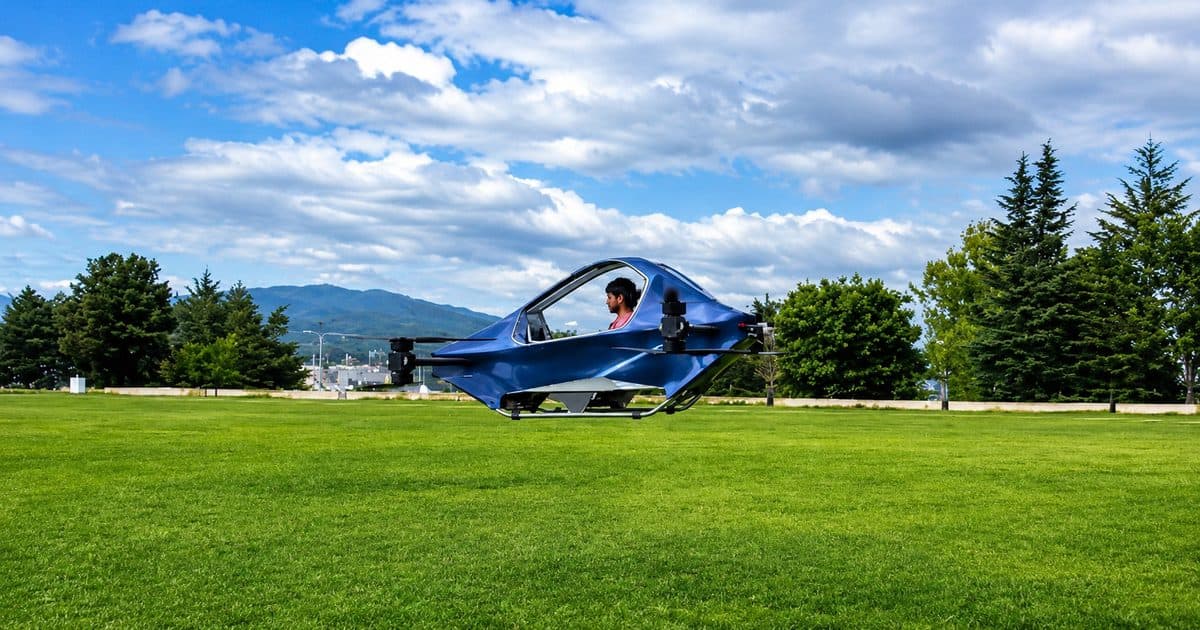
An innovator from the hills of Uttarakhand has done something that sounds straight out of science fiction — he built a personal flying vehicle that runs entirely on electricity, with no petrol, diesel, or aviation fuel involved, and then successfully flew it.
Ravi Tamta hails from Kaflikhan village, tucked near the famous Jageshwar Dham temple in Almora district, Uttarakhand. Far away from any big-city tech hub, Tamta spent close to 13 years working on his dream of building a flying vehicle that ordinary people could one day use. That dream now has a name: HAPIDA SKYNeX, developed through his own startup, Hapida Sky Private Limited.
The SKYNeX is a single-seater personal flying vehicle built on modified multirotor drone technology — think of it as a heavy-duty drone engineered and scaled up to safely carry a human pilot. The biggest highlight is its power source: it runs purely on electricity, with zero dependence on aviation fuel, ethanol, petrol, diesel, or CNG, making it a zero-emission, zero-tailpipe vehicle.
The recent test flight, conducted on open ground in Almora, marks the first major milestone in the project after years of research and development. Videos of the multicopter lifting off with a pilot on board have since gone viral across social media.
Uttarakhand's terrain is part of what makes this story so meaningful. The state's steep hills, winding mountain roads, and stretches without proper connectivity make everyday travel time-consuming and, in emergencies, sometimes even dangerous. Tamta has pointed out that a roughly 40-km journey between hill towns can take about 90 minutes by road — a trip he believes a future version of an aerial vehicle could cover in around 10 to 15 minutes. It's worth being clear that this is Tamta's projected use case and not something the test flight itself has proven yet — no official range, speed, or battery specifications have been released so far.
Beyond personal transport, experts see real potential here for disaster response, landslide relief operations, and delivering medical supplies to remote villages that are otherwise cut off during emergencies — situations where every minute saved can matter.
What makes this story stand out isn't just the machine — it's where it came from. Tamta isn't backed by a large corporation, a big-city lab, or millions of dollars in funding. He's a young innovator from a small village who spent over a decade chasing an idea, and it's now flying.
The achievement caught the attention of Uttarakhand Chief Minister Pushkar Singh Dhami, who publicly congratulated Tamta, calling it proof that talent and innovation aren't limited to India's traditional tech centres. Union Civil Aviation Minister Ram Mohan Naidu Kinjarapu also acknowledged the milestone.
It's important to note that the HAPIDA SKYNeX is still very much a prototype. Before it can become a real mode of transport, it will need extensive further testing, safety validation, and regulatory approval from aviation authorities — a process that typically takes years for any new aerial vehicle. Details like battery capacity, flight duration, payload capacity, and charging time haven't been disclosed yet either.
Still, for a project that started in a small Himalayan village with nothing but an idea and years of persistence, getting an electric flying vehicle off the ground — literally — is no small feat. It's a glimpse of what India's grassroots innovation ecosystem is capable of, and a story worth watching as it develops.
Courtesy: India TV News, Business Today, NewsBytes, and India.com. This article has been shared for informational purposes; all rights to the original content belong to the source publication.