
Corrosion Protection
Corrosion Costs ₹14 Lakh Cr a Year, Power Sector Worst Hit: Nomura
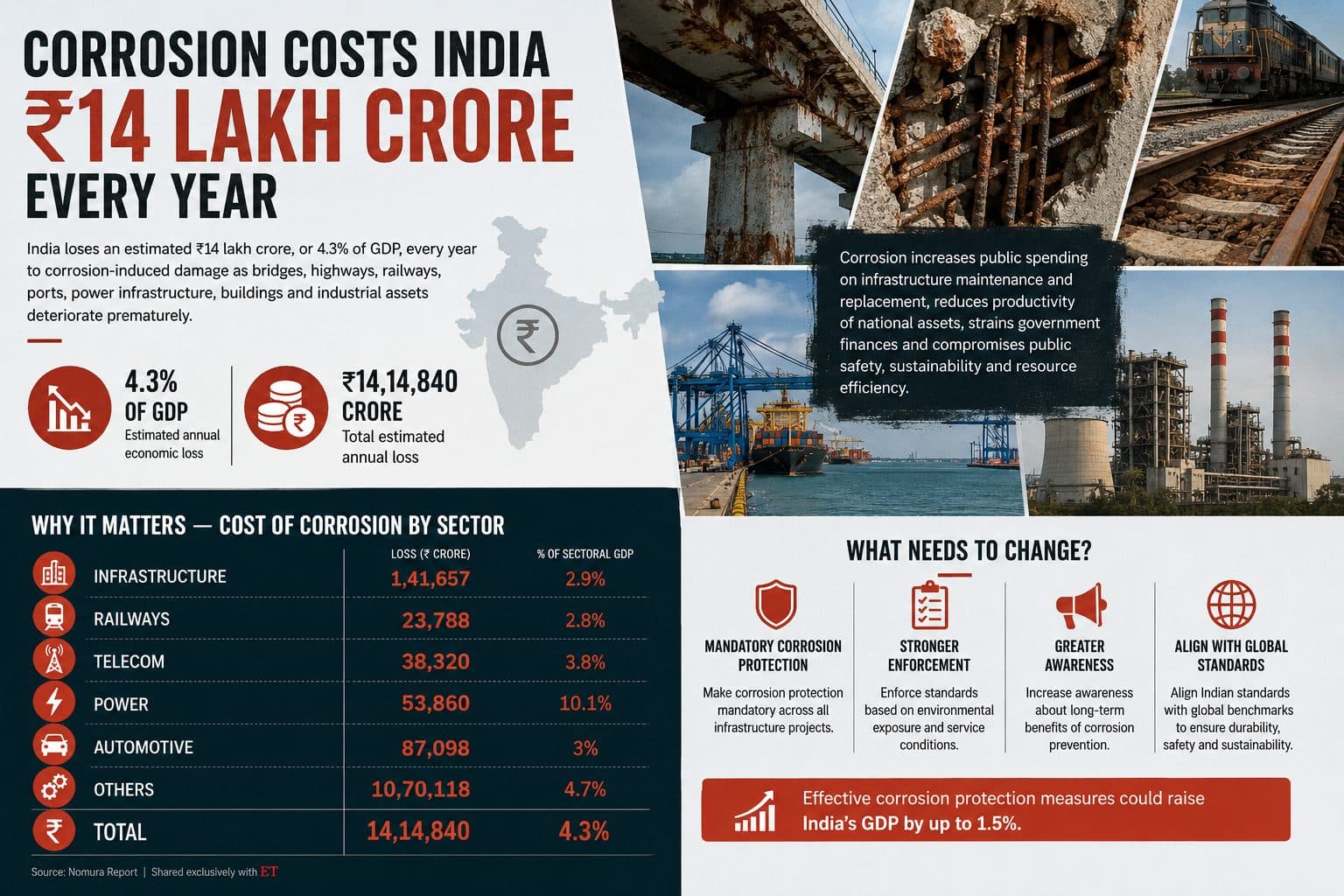
India loses an estimated ₹14 lakh crore, or 4.3% of GDP, every year to corrosion-induced damage as bridges, highways, railways, ports, power infrastructure, buildings and industrial assets deteriorate prematurely, according to a Nomura report.
The report, shared exclusively with ET, estimates the biggest impact is on the power generation and transmission sectors, followed by telecommunications, automotive, infrastructure and railways.
"India's above-average cost of corrosion and high corrosion susceptibility highlight a growing macroeconomic risk, with significant negative impact expected on GDP in future," it said in the report, adding that effective corrosion protection measures could raise GDP by up to 1.5%.
According to the report, corrosion increases public spending on infrastructure maintenance and replacement, reduces the productivity of national assets, strains government finances and compromises public safety, sustainability and resource efficiency.
Citing the US and Japan, the report said many developed countries classify infrastructure according to environmental exposure and prescribe corrosion protection. India, by contrast, largely follows uniform specifications across different climatic conditions.
"This is especially important in the monsoon, when humidity and saline conditions accelerate infrastructure deterioration," it said, recommending mandatory corrosion protection, stronger enforcement, and greater awareness to improve the durability and safety of infrastructure.
"Aligning Indian standards with global benchmarks is critical for ensuring the best practices are followed for greater durability of long-term assets in India," it said.
While Bureau of Indian Standards norms mandate corrosion protection and list methods such as inhibitors and coatings, they do not specify which techniques — such as zinc coating, epoxy coating, hot-dip galvanisation or weathering steel — should be used under specific conditions. This gives contractors the flexibility to adopt only the minimum requirements.
Roads and bridges, particularly in corrosion-prone and high-traffic areas, are exposed to water, pollution and heavy loads, accelerating deterioration and underscoring the need for effective corrosion protection to prevent loss of life and damage to public assets.
Why it matters — cost of corrosion by sector: Infrastructure ₹1,41,657 cr (2.9% of sectoral GDP); Railways ₹23,788 cr (2.8%); Telecom ₹38,320 cr (3.8%); Power ₹53,860 cr (10.1%); Automotive ₹87,098 cr (3%); Others ₹10,70,118 cr (4.7%); Total ₹14,14,840 cr (4.3%).
Courtesy: The Economic Times. This article has been shared for informational purposes; all rights to the original content belong to the source publication.